


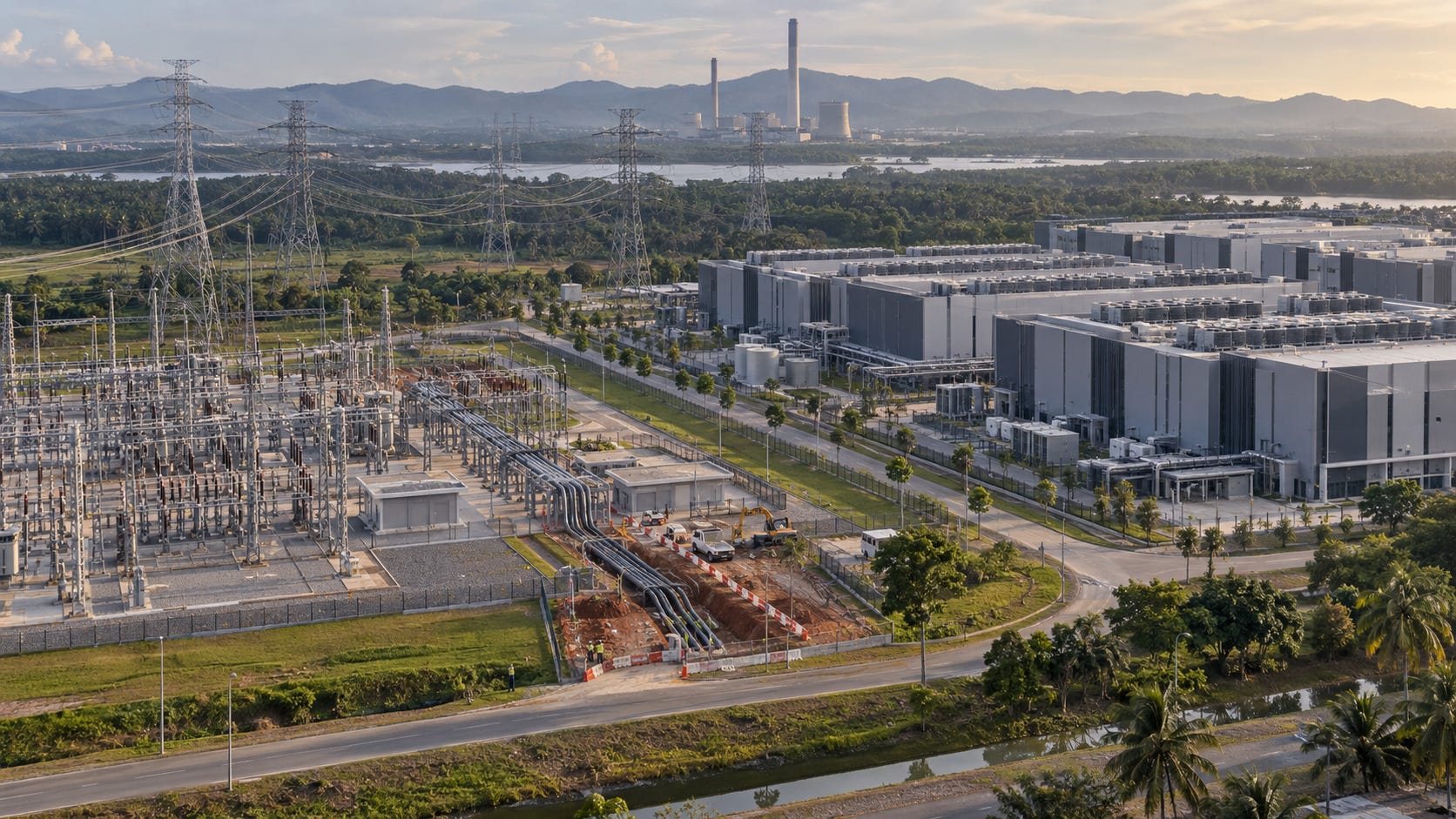
The brief — On 8 September, Malaysia’s Energy Commission CEO said data centres had accounted for 9.3% of electricity consumption during the second week of August, according to Reuters, while Firmus announced on the same day an agreement to supply OpenAI from two Malaysian sites. Read together, the announcements frame an operating question: how will expanding commercial commitments be matched by dependable electricity supply at the places and times it is needed? Reuters, Firmus
What the pipeline measures
As of June 2026, Tenaga Nasional Berhad (TNB) reported 61 secured data-centre projects representing 8.35 GW of maximum demand, but that total combines commitments at different stages of delivery. Forty-two projects representing 5.65 GW were completed or “in system”, 16 representing 2.21 GW were under construction, and three representing 0.49 GW had reached the signed electricity-supply-agreement stage. TNB 2Q FY2026 Analyst Briefing, slide 4
Actual load utilisation stood at 1.256 GW in June, far below both the secured total and the maximum demand associated with projects classified as completed or “in system”. That comparison requires care, because such a classification does not mean a project immediately draws its full maximum demand: utilisation can increase progressively as equipment is commissioned and customer workloads arrive. The gap between the figures cannot therefore establish delays or a project-conversion rate by itself. TNB 2Q FY2026 Analyst Briefing, slides 3–4
Secured maximum demand establishes the scale for which the system must plan, whereas actual load and its timing determine what it must deliver. Planning therefore depends not only on completing the infrastructure that serves each project, but also on understanding how quickly customers will use the capacity allocated to them.
Delivery has several clocks
Supplying a data centre depends on a chain of linked programmes whose schedules need to converge: generation must be planned and built, transmission reinforced, local connections completed, facilities energised and customer load progressively introduced. Much of this work can proceed in parallel, but additional generation cannot compensate for an unfinished local connection, just as a completed connection does not establish that firm supply will remain available throughout a facility’s operating life.
The Firmus agreement illustrates this distinction between commercial commitment and physical delivery. Although the multi-year contract confirms a customer for dedicated AI compute, the announcement does not disclose the locations, individual capacities, connection status or precise operating dates of the two Malaysian sites; nor does one AI-specific agreement establish the workload composition of Malaysia’s wider data-centre pipeline. Firmus announcement
The operating task is therefore to match infrastructure delivery to a demand profile that becomes clearer as projects advance and workloads arrive. If those schedules diverge, customer service could be delayed or infrastructure could be completed before the associated load materializes, although neither outcome can be inferred from the aggregate pipeline alone.
Johor makes the question local
Johor accounted for 29 secured projects and approximately 5.6 GW, equivalent to about 67% of TNB’s secured maximum demand. Because so much of the pipeline is concentrated in one state, the location of available capacity matters as much as the national total. TNB 2Q FY2026 Analyst Briefing, slide 4
System-wide generation adequacy and local deliverability are separate questions: transmission routes and connection capacity must support the load where it develops. TNB has separately announced wider transmission reinforcement, including a 500 kV east-coast backbone targeted for completion in 2030, which provides evidence of broader grid investment but is not linked in the announcement specifically to Johor or to the resolution of any data-centre project’s local connection requirements. TNB transmission announcement
Johor’s concentration identifies where coordination matters most, but it does not prove that congestion is already delaying every project. Evidence about particular connections, available capacity and delivery dates would be needed before a bottleneck could be established.
The bridge to new generation
Reuters reported that officials expected no additional gas-fired capacity during 2026 or 2027, while the Economy Minister identified approximately 9 GW as being required by 2032 to address wider demand growth and plant replacement as well as data-centre demand. With new supply taking time to prepare, the near-term operating question is how the existing system accommodates increasing load, and the Energy Commission has described optimising existing capacity during this period. Reuters
That bridge makes plant availability, dependable fuel supply and the sequencing of retirements relevant alongside construction schedules. Renewable-energy procurement can contribute to the mix, but neither solar nameplate capacity nor an annual energy purchase demonstrates uninterrupted supply without balancing, storage or backup arrangements. These are delivery dependencies rather than evidence of an imminent shortage, while all future commissioning dates remain schedules rather than assured outcomes.
What to watch
The August consumption figure should be read as a short-period observation rather than a permanent baseline. More revealing evidence will come from successive measurements of actual load, connected maximum demand and project progress, assessed against the infrastructure serving each cluster and the time taken to complete individual connections.
Commissioning performance, reserve margins and service reliability would show whether electricity delivery is keeping pace, while disclosed arrangements for connection costs, network reinforcement and backup would clarify who carries the financial exposure. Local congestion, fuel constraints and schedule slippage remain plausible operating risks, but their effects should not be presented as established outcomes without evidence of delays, reliability deterioration or unresolved cost allocation.
The pattern
Malaysia already has a substantial secured pipeline and measurable data-centre consumption, alongside plans to expand the electricity system that supports them. The execution test is whether those elements develop together: rising utilisation supported by timely infrastructure and stable service would validate the delivery model, whereas repeated connection delays, deteriorating reliability or unresolved cost responsibilities would expose its weaknesses. The investment story ultimately depends on that operating performance.