


The brief - The Public Investment Fund halted construction on The Line in September 2025, with 2.4 kilometres of foundations built against 170 originally announced. The capital didn't disappear — it moved. AI infrastructure, data centres, and a new operating vehicle called Humain are absorbing the reallocated capex. The pattern echoes Abu Dhabi's pivot fifteen years ago, and is starting to redraw the operator map across Vision 2030.
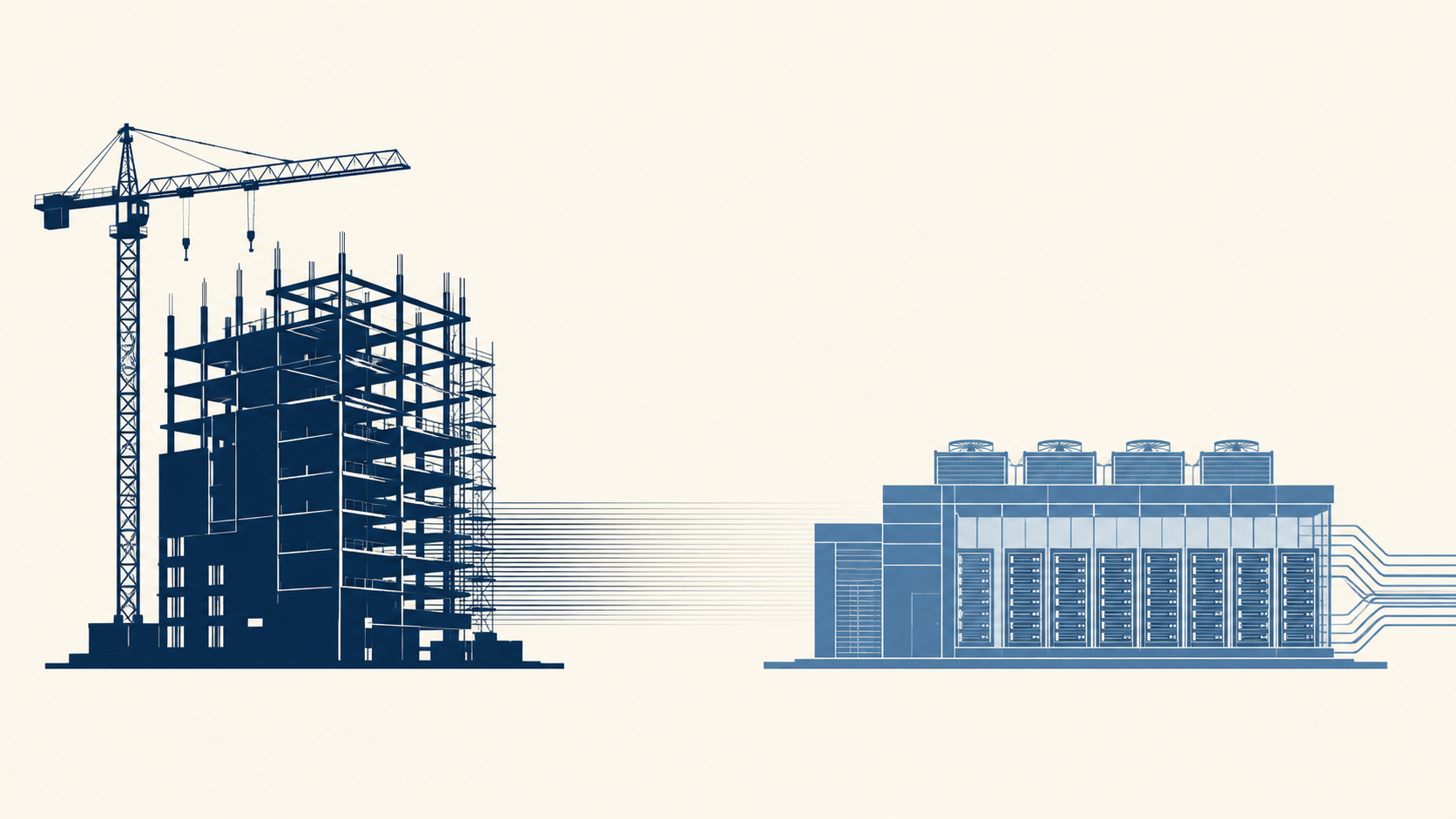
On 16 September 2025, Saudi Arabia’s Public Investment Fund halted construction on The Line, pending strategic review. After four years of work, Bloomberg reported that around 2.4 kilometres of foundations had been completed against the 170 kilometres originally announced — roughly 1.4% of the project. The PIF disclosed an $8 billion write-down across its giga-project portfolio in its end-2024 accounts, with Neom the single largest contributor, according to CNBC. No mirrored superstructure has emerged above ground. No resumption date has been announced.
The headline reads as a cancellation. The signals suggest something more specific: the capital didn’t disappear, it moved. The more revealing story is where it went, and what it could mean for the operators who built their books on the original Vision 2030.
Signals of reprioritisation
In late October 2025, on the sidelines of the Future Investment Initiative in Riyadh, Saudi Arabia’s Minister of Economy and Planning Faisal Alibrahim told CNBC the Kingdom was “reprioritizing a little bit towards sectors that need it the most, and today it’s technology, artificial intelligence.” Three months later in Davos, he framed the broader shift as a move away from five years of going “full throttle” on ultraluxury projects toward a focus on efficiency.
The capital flow tracks the language. In February 2025 at LEAP, Neom and DataVolt signed a $5 billion agreement to build a 1.5-gigawatt AI data centre campus in Oxagon, with the first 300 MW phase due in 2028. In May 2025, PIF launched Humain, a wholly-owned AI operating company chaired by Crown Prince Mohammed bin Salman. The same month, Google Cloud and PIF announced a $10 billion joint investment to build a global AI hub, launched with Humain. Oracle has committed $14 billion over ten years to Saudi cloud and AI infrastructure. AWS has pledged $5.3 billion for a new Saudi cloud region. Groq has committed $1.5 billion through Aramco Digital. In October 2025, Aramco and PIF signed a non-binding term sheet for Aramco to take a significant minority stake in Humain — consolidating major AI assets under a single PIF-controlled vehicle.
The GCC data centre market is forecast to grow from $3.48 billion in 2024 to $9.49 billion by 2030 — an 18.2% compound annual growth rate.
Two different operational disciplines
Building a 170-kilometre linear city and operating a hyperscale data centre are not the same exercise. The contractor pool is different. The supply chain is different. The skills, certifications, and governance models are different. Programme management on a megacity is a 15–25 year horizon dominated by civil works, utilities, and large EPC consortia. Programme management on an AI campus is a 24–36 month horizon dominated by power engineering, cooling, fibre, and high-density compute integration.
A capital shift of this kind tends to translate into an operational shift. The operators who win on data centres are not automatically the ones who won on linear cities. The early indications point in that direction: DataVolt, a Saudi sustainable data centre developer founded in 2023, secured a $5 billion Neom package — a contract that two years earlier would more likely have been awarded to a global EPC for a different kind of project. Whether this is the start of a broader operator rotation, or an isolated win, is one of the variables to watch.
The Abu Dhabi precedent
Abu Dhabi lived a comparable pivot fifteen years ago. In 2008, oil and gas accounted for 81% of Mubadala’s revenues. By 2010, that figure had fallen to 38%, with aerospace and infrastructure rising as new revenue pillars. The pivot was deliberate, sovereign-fund-led, and built around new operating platforms: Emirates Aluminium, Strata Manufacturing (with Airbus contracts), Mubadala GE Capital, the Sowwah Island financial district. Mubadala’s COO described the shift at the time as the original investment thesis “playing out.”
The mechanism is recognisable. A sovereign fund with a long horizon decides which sectors will define the next decade, capitalises new vehicles, and builds operator pipelines that did not exist before. Mubadala did not redeploy oil contractors into aluminium smelting; it built EMAL. PIF, having launched Humain in May 2025, is following a similar logic in AI.
What to watch over the next 18 months
Three signals will tell whether this reallocation is durable or opportunistic.
First, the ratio of new capital commitments going to AI and data infrastructure versus traditional construction across PIF’s full portfolio in 2026–2027. A reversal at $85+ oil would point to tactical reallocation rather than structural change.
Second, the contractor profile on the active data-centre packages — power, cooling, fibre, mechanical and electrical core works. Whether these go to Saudi national champions like DataVolt, to specialised regional players, or to global engineering firms repositioning into the new segment will define the next operator generation.
Third, the trajectory of operators historically dominant on Vision 2030 physical construction — Bechtel, AECOM, ACWA Power, Air Products. Bechtel was confirmed as project management consultant on Trojena in January 2025, suggesting continuity rather than displacement on selected components. The question is which packages they retain through 2027, and which migrate elsewhere.
The operational test
For operators already engaged on Vision 2030 or evaluating entry, the question is not whether Saudi is slowing — in aggregate, it isn’t. The question is which segment of the Saudi capex stack is compatible with their delivery model over the next five years. Elements of capital reallocation are increasingly visible. The operational reallocation, if it comes, will be written contract by contract.