


The brief - On 12 May 2026, VinFast announced the sale of its Vietnamese manufacturing arm for $530 million to a consortium that includes its founder. The deal is presented as a shift toward an asset-light model. The structure echoes the Geely playbook more than the Apple one, and raises three operational variables worth tracking over the next 18 months.
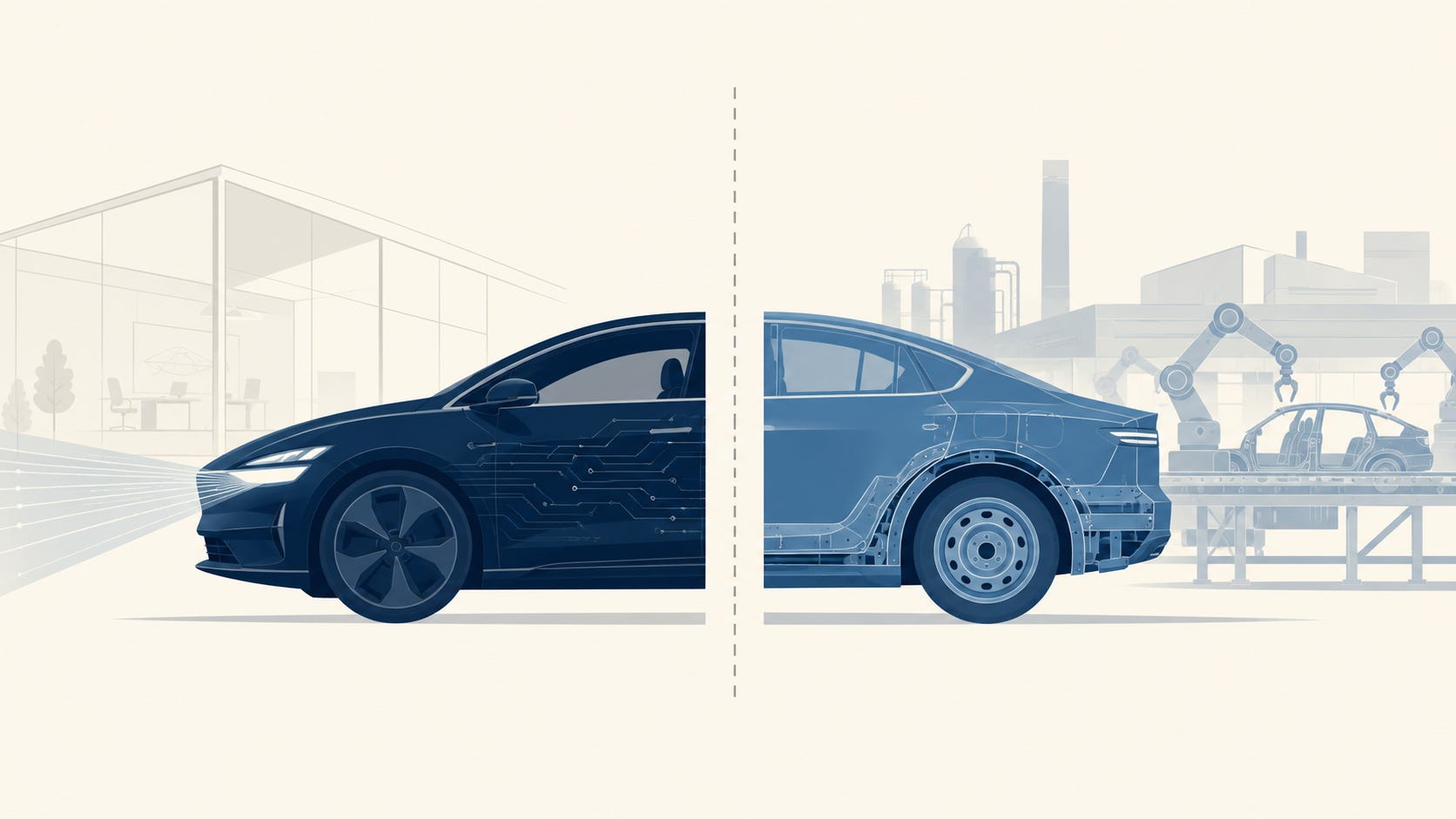
On 12 May 2026, VinFast Auto Ltd. filed with the U.S. Securities and Exchange Commission a plan to restructure its Vietnamese operations. VinFast Trading and Production JSC (VFTP) — until now the subsidiary holding both manufacturing and strategic functions — will be split in two. A new entity, VinFast Vietnam JSC (VFVN), will retain R&D, intellectual property, sales, and after-sales operations. VFTP will keep the manufacturing assets, including the Hai Phong and Ha Tinh plants and the associated battery operations in the Vung Ang Economic Zone. VinFast will then divest its full stake in VFTP for approximately $530 million, with closing targeted for Q3 2026 subject to shareholder and creditor approvals.
The mechanics
The $530 million consideration is based on the consolidated net book value of VFTP as of 31 March 2026. An independent financial advisor opinion produced by Grant Thornton (Vietnam) under a discounted cash flow methodology placed the mid-point valuation at $106 million. The transaction is priced on book value rather than discounted cash flow.
The acquiring consortium is led by Future Investment Research and Development JSC. The controlling investor is Nguyen Hoai Nam, CEO of Berjaya Group Vietnam — a long-standing partner of the Vingroup ecosystem. Pham Nhat Vuong, founder of Vingroup and CEO of VinFast, participates in the consortium as a minority investor with a stake below 5%. After internal transfers post-closing, the holding vehicle Tuong Lai — formerly Novatech, originally established by VinFast in 2024 — will hold approximately 95.5% of VFTP. Vietnamese production will continue under a manufacturing and supply agreement between VFVN and VFTP. Operations in India and Indonesia are unaffected.
A structural question rather than an event
VinFast presents the restructuring as a transition toward an asset-light model. The reference point implicitly offered is Apple, which separated design from production through Foxconn from 1996 onward — while maintaining tight operational and quality governance over its supply chain throughout.
The relevant question for the EV sector in Asia is not whether asset-light is valid in principle. It is at which stage of maturity a national champion can credibly make that transition, and through which governance structure. Apple moved once design and brand had become the dominant source of value. Boeing attempted a comparable outsourcing-heavy model on the 787 programme between 2007 and 2013 without the technical governance to support it, and eventually re-internalised critical components. Tesla and BYD, two dominant EV manufacturers in Asia and the West, have held the opposite line — vertical integration retained as a strategic moat.
VinFast in 2026 sits earlier on the curve. The brand is not yet globally installed, and Q4 2025 closed with a $1.34 billion net loss. The asset-light pivot is therefore happening earlier in the brand and R&D maturity curve than the standard reference cases, and in a context of significant financial pressure. The question is which governance model accompanies it.
The Geely precedent — with caveats
A closer regional precedent than Apple-Foxconn is Geely. From 2010 onward, Li Shufu structured the group through layered cross-shareholdings: Volvo (2010), Lotus (2017), partnerships with Proton, shared platforms, and capital coordinated between the founder and the holding. The result was uneven — Volvo recovered strongly, Lotus pivoted toward EV, while Proton delivered more mixed results. The mechanism is recognisable in the VinFast structure: a founder retaining a transversal capital presence and operations piloted through inter-entity contracts.
The parallel has limits. Geely operates a multi-brand industrial ecosystem with capital integration between distinct manufacturers. VFTP, by contrast, becomes a contract manufacturer initially captive to a single principal. The shared element is the governance logic — capital alignment around the founder, contracts as the operational interface — not the industrial setup itself.
What to watch over the next 18 months
Three variables will shape how the structure plays out.
First, the manufacturing and supply agreement between VFVN and VFTP. Its terms are confidential, but they will define the actual balance of operational control: quality standards, product evolution validation, delivery penalties, exclusivity clauses. The agreement, more than the share transfer, is the operational document.
Second, the capital trajectory of VFTP. How the 95.5%/<5% distribution evolves over 24 months will signal whether VFTP is moving toward genuine third-party independence or remaining a satellite of the Vingroup ecosystem.
Third, the customer mix of VFTP. If the platform produces only for VinFast, it remains a captive arrangement. If it opens production to other clients — Chinese EV brands expanding in ASEAN, Indian manufacturers seeking local assembly, regional new entrants — it becomes a genuine contract manufacturer. This variable will distinguish a restructuring from a transformation.
The pattern
The asset-light narrative is consistent on paper. What this transaction reveals, beyond VinFast itself, is the model under which Southeast Asian industrial champions are restructuring as they reach scale — neither the Apple model nor the Tesla model, but a layered ecosystem in which capital, contracts, and operational governance are distributed across affiliated entities. For operators evaluating the Asian EV landscape, the next 18 months will not tell whether VinFast made the right call. They will tell what kind of industrial governance model is emerging in the region’s second wave of mobility champions.