


The brief — On 31 August 2026, Bank Indonesia and the Monetary Authority of Singapore made their bilateral Local Currency Transaction (LCT) framework operational. Participating banks can now quote the Indonesian rupiah (IDR) directly against the Singapore dollar (SGD) and process eligible trade, investment and cross-border payments in the two currencies. The announcement marked the transition from bilateral policy cooperation to an operating bank-and-account structure. Bank Indonesia
The framework gives companies another route for moving money between two closely connected economies. It does not prove that the route will be cheaper, faster or independent of the dollar. It removes a possible customer-facing conversion step, but not the liquidity and hedging work required to make that price executable.
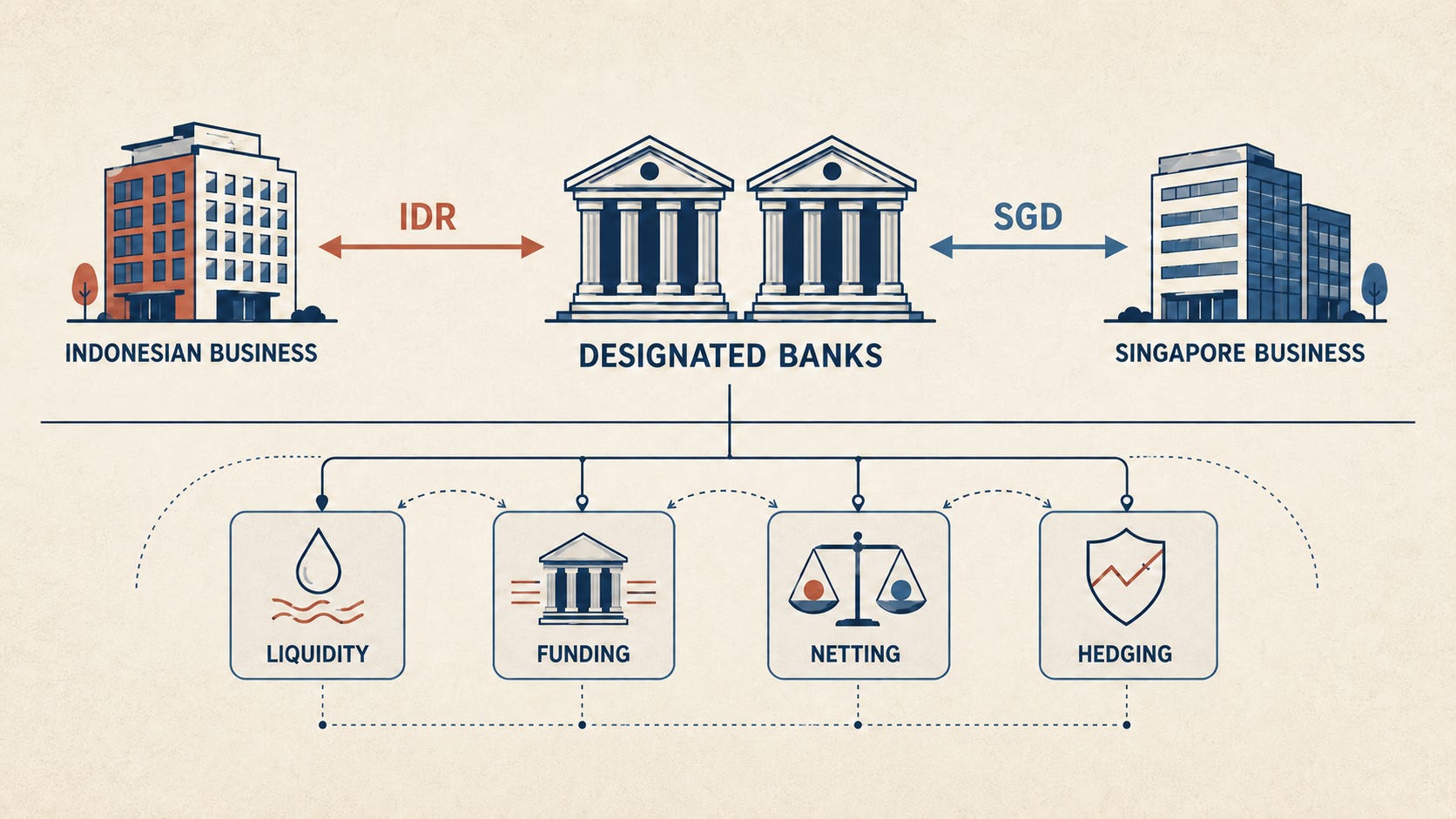
A governed channel
The process began with a bilateral agreement in 2022. A Quick Response Code Indonesian Standard (QRIS)–NETS payment linkage followed in 2023, operating guidelines in April 2026 and Indonesia’s implementing regulation on 14 August. Bank Indonesia, 2023 QR launch, BI–MAS 2026 launch, PADG No. 25/2026
The latest step changes the currency and dealer architecture more clearly than the payment infrastructure. The public documents reviewed do not describe a new clearing house, common settlement system or payment-versus-payment mechanism. Together, the framework and implementing rules create a regulated network of appointed cross-currency dealer banks supported by special accounts, reporting requirements and eligibility rules.
Nine banks have been designated in Indonesia and three—DBS, OCBC and UOB—in Singapore. On the Indonesian side, participating banks must display an executable IDR–SGD quotation at least once each business day. The rules also permit spot and several hedging instruments. Full Bank Indonesia regulation
The scope extends beyond merchandise trade to qualifying services, direct investment, income flows and some related financing. Under the Indonesian rules, an eligible transaction denominated in another currency may be expressed in an SGD equivalent and paid in SGD. Changing the payment currency, however, does not remove the exposure embedded in the underlying contract.
The dollar can leave the transaction and remain in the system
The framework is better understood as selective transactional diversification than as de-dollarisation.
A customer using a direct quote may no longer need two separately presented conversions through the US dollar. Yet nothing establishes that banks will price, fund and hedge every transaction without reference to dollar markets. Indonesian banks may manage SGD positions using swaps or conversions involving other currencies.
A direct quote changes what the customer transacts. It does not necessarily reveal how the bank constructs or hedges that price.
Neither currency is pegged to the US dollar. Indonesia operates a floating exchange arrangement, while Singapore manages the SGD against a trade-weighted basket within a policy band. Companies and banks can nevertheless retain dollar exposure through contracts, debt, commodities, imported inputs and hedging markets. IMF, MAS
The framework may therefore reduce demand for dollars as a vehicle currency in a payment without materially reducing overall dollar exposure.
Liquidity is the operating test
The authorities have created legal permission, account structures and a banking network. The question is whether its direct prices can beat existing arrangements.
There is no public evidence yet on direct IDR–SGD spreads, executable sizes, forward-market depth or continuous quotation. An obligation to show one executable price each business day is not continuous two-way market making. Permitting hedging instruments does not demonstrate their availability at useful sizes, maturities and prices.
If demand for one currency persistently exceeds demand for the other, banks must absorb, fund, net or hedge the residual position. The Indonesian rules permit them to use currency balances, borrowing, swaps, conversions and position-squaring across the designated network. Their depth and cost in operation remain unknown.
The decisive comparison is not direct settlement versus no direct settlement. It is the price and operational simplicity of the new route versus the established route companies already use.
That comparison extends beyond the exchange rate. Businesses may still need underlying-transaction documentation, account arrangements and compliance review. They may also have centralised treasury systems, dollar-denominated contracts and established hedging policies. Formal eligibility will not overcome those habits unless the new route offers a repeatable advantage.
What to watch
The earliest meaningful evidence will come from use rather than further declarations. Transaction volumes and repeat corporate customers would show whether the framework has moved beyond launch activity. Published spreads and executable sizes would reveal whether a direct IDR–SGD quote competes with a synthetic dollar cross. Customer forward and swap activity would indicate whether companies can manage exposure rather than simply make spot payments.
Bank guidance, onboarding and visible product availability will show when formal designation becomes accessible infrastructure. The direction and balance of currency flows, together with banks’ netting and hedging activity, would indicate the inventory and funding pressures they manage.
The strongest test will arrive during a period of dollar volatility. If direct IDR–SGD liquidity remains available and competitively priced, the corridor may offer genuine transactional diversification. If banks simply reprice scarce dollar-linked funding behind the direct quote, the framework will have changed the route more than the underlying dependency.
The pattern
The bilateral framework is not an ASEAN settlement system. It is one connection within a broader regional effort to expand payment connectivity and local-currency use. Regional integration may emerge through accumulating bilateral bank networks, QR links and compatible regulations rather than through one institution. But each corridor may have different rules, banks and market depth.
The announcement establishes the channel. Adoption, pricing and resilience will determine whether it becomes infrastructure.